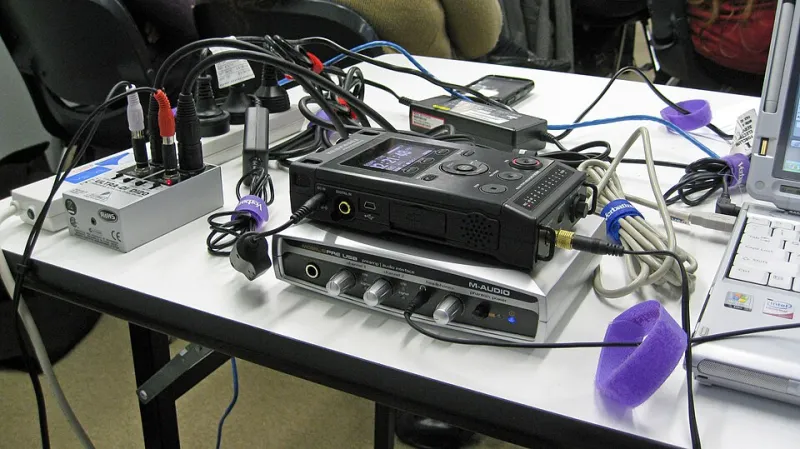
Photo: Stephan Ridgway from Sydney, Australia, CC BY 2.0, via Wikimedia Commons
The invite lands in your inbox and your first instinct is to treat it like a stage. You start drafting talking points, scrolling your own catalog for the clip you want to walk away with, and quietly figuring out where the camera should point. Somewhere in that flurry, the actual show you were invited onto disappears.
Here's the part nobody teaches: being a guest is its own craft. It has very little to do with how interesting you are and almost everything to do with how useful you make yourself for forty-five minutes. The people who get asked back are rarely the loudest ones in the room. They're the ones who made the host look sharper, made the audience feel smarter, and left behind a clip that belonged to everyone.
The Whole Rule, Compressed
Show up as a supporting character in somebody else's story, and be the best supporting character they've ever had. That's it. Your job on that mic is not to prove you deserve your own show. Your job is to make the episode the host has been trying to make for months finally click.
Think about the TV guest stars who stick. They rarely get the biggest speech. They get the moment that makes the lead character's arc land. You're aiming for that.
Prep Like an Opening Act, Not a Headliner
Most people prep for a guest spot by writing down what they want to say. Flip it. Spend the first hour of your prep writing down what the host wants to walk away with. Listen to three recent episodes, not the famous one from four years ago. Notice what questions they ask twice because they never got a satisfying answer. Notice the running bit. Notice where they get excited.
Then build two or three things you can genuinely deliver—a story with a real ending, a specific tactic someone could use tomorrow, a contrarian take you can defend under pressure. Two or three. Not twelve. Guests who arrive with a list of eleven points end up cramming all of them into the first eight minutes and leaving dead air for the rest.
Bring One Thing They Can't Get Without You
A guest spot has a simple economy: you're trading access for exposure, and access means something only you can say. Not a secret, not a scandal—a perspective. You were in the room. You made the mistake. You saw how the sausage got made.
The test is easy. If a well-read stranger could have said your point, it's filler. If it requires having lived your specific weird life, it's a gift. Give away two or three of those, and you'll be quoted for a year.
The Handoff Is the Entire Trick
Watch a great guest and notice how often they end a thought by handing it back. Which is basically what you were saying about the deadline stuff. Does that match what you've seen with your team? That's not politeness. That's craft. It creates a conversation instead of a monologue with a second chair in the frame, and it gives the host an easy path to the moment they actually wanted to get to.
Hosts remember the guests who took care of the room. They'll say it differently—great energy, super easy to talk to—but what they mean is that the episode cut together in half the time.
The Small Things That Cost You the Callback
- Never treating the interview as an ad. Mention your thing when asked, once, warmly. Then get back to the conversation.
- Never correcting the host's framing on air unless it's an actual error that would hurt them. Save the notes for after.
- Never overrunning. If you're booked for forty minutes, build material for thirty. Tight is generous.
- Never going quiet through the setup. A guest who only wakes up for their own story reads as bored on camera, and the audience notices before the host does.
The Follow-Up Almost Nobody Sends
The day after, send a short note that isn't thanks so much, that was fun. Name one thing the host said that stuck with you, and offer a specific follow-up: a name they should book, an example you forgot to mention, a stat you promised and then didn't have handy. If you can, boost the episode without being asked. Not with a story that says so honored, but with a real sentence about why the episode is worth someone's commute.
That's the whole move. The clip gets you a spike. The follow-up gets you a relationship.
Why It Compounds
One good guest spot produces one good clip. Five good guest spots produce a reputation—the person who makes other people's work better. In an industry where everyone is fighting to be the face of something, being the person hosts lobby for is a genuinely rare position, and it's much harder to lose.
So next time the invite comes, resist the urge to make it about you. Make it about the show you're about to be part of, and then make yourself unforgettable inside it. That's the guest star rule, and it's the only version of fame that keeps calling you back.